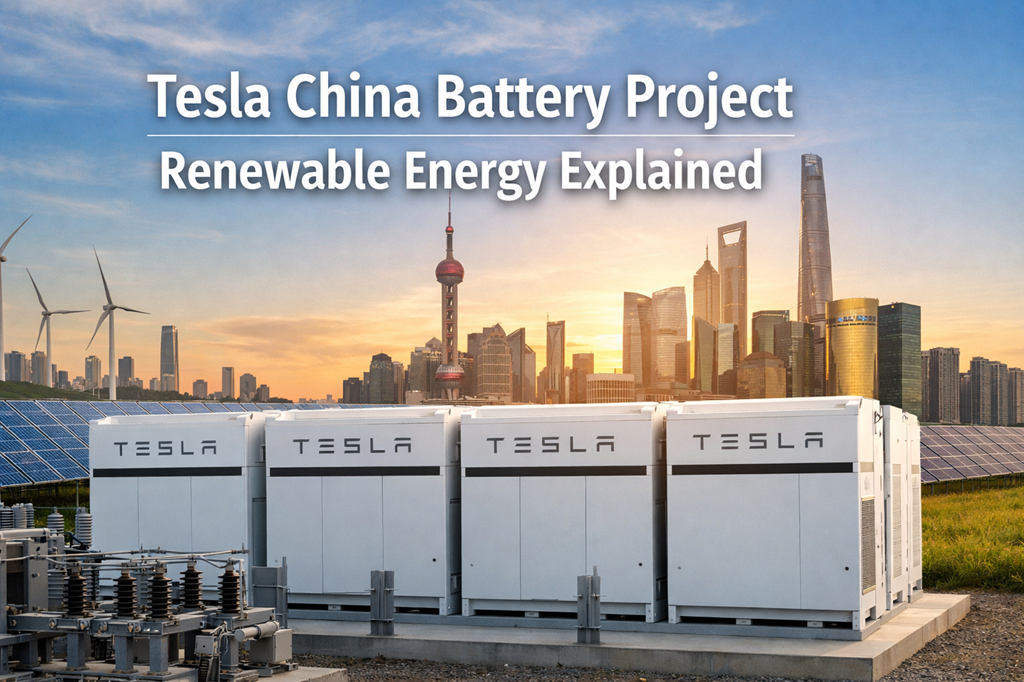
In June 2025, Tesla signed a 557 million dollar agreement with the Shanghai municipal government to build its first major grid side battery storage project in China. The project is expected to become China’s largest grid side battery storage station. It uses Tesla’s Megapack technology to stabilize Shanghai’s renewable heavy electricity network.
At the same time, Tesla’s new Shanghai battery megafactory began production in February 2025. The plant can produce 10,000 Megapack units per year, totaling about 40 gigawatt hours of storage capacity annually.
Together, these developments mark a clear shift. Tesla’s energy footprint in China has moved from manufacturing vehicles to building infrastructure scale renewable energy solutions.
Tesla’s Shift From Manufacturing to Energy Infrastructure
For years, Tesla focused in China mainly on electric vehicle production. However, the Tesla China Battery Project Renewable Energy initiative shows a deeper move into power infrastructure.
Instead of only producing cars, Tesla now supports grid level energy storage. Therefore, the company becomes part of China’s electricity system, not just its automotive market.
This shift matters because renewable energy expansion requires large storage systems. So, Tesla’s role now extends beyond transportation into national energy stability.
The Shanghai Grid Scale Battery Project
Scale and Investment
Tesla signed a 4 billion yuan agreement, equal to about 557 million dollars. This agreement supports what is expected to be China’s largest grid side battery storage station.
The project directly addresses urban electricity pressure in Shanghai. As renewable capacity rises, power supply must remain stable. Therefore, large battery stations become critical.
Technology: Megapack as a Smart Regulator
The project uses Megapack technology, Tesla’s utility scale lithium ion battery system.
Each Megapack:
- Stores about 3.9 megawatt hours of energy
- Can power roughly 3,600 homes for one hour
- Integrates battery cells, inverters, and cooling systems
Because Megapacks respond quickly to grid signals, they act as a smart regulator. When renewable output drops, stored energy flows into the grid. When supply exceeds demand, the system absorbs extra power.
As a result, power fluctuations decrease and reliability improves.
Project Partners
This grid project is a collaboration between:
- Tesla
- The Shanghai municipal government
- China Kangfu International Leasing
Such partnerships show that this initiative is not a standalone factory plan. Instead, it is integrated into Shanghai’s urban power strategy.
The Shanghai Megafactory: Production Backbone
Launch and Output
Tesla began production at its Shanghai battery megafactory in February 2025. The factory is designed to produce 10,000 Megapack units annually, totaling around 40 GWh of energy storage capacity.
This production scale allows Tesla to serve both domestic and international markets.
Global Export Role
Although the Shanghai grid side project serves China, the factory also exports Megapacks to:
- Australia
- Europe
- Asia Pacific markets
Therefore, the Tesla China Battery Project Renewable Energy initiative supports global renewable expansion as well.
Supply Chain and CATL
Tesla continues sourcing battery components and cells from Chinese battery leader CATL, which holds roughly 40 percent of global market share.
This partnership highlights an important point. Tesla competes with domestic companies in storage projects, yet it also relies on China’s established battery supply chain.
Strategic Context: Why This Project Matters
National Energy Goals
China aims to add about 40 gigawatts of battery powered storage capacity by the end of 2025. Rapid solar and wind deployment has created grid balancing challenges.
Therefore, battery storage supports:
- Renewable integration
- Urban power reliability
- Reduced reliance on fossil fuel peaker plants
The Tesla China Battery Project Renewable Energy initiative aligns directly with these national goals.
Market Competition
Tesla competes with domestic leaders such as:
- CATL
- BYD
China’s energy storage sector is forecast to reach 8 billion dollars in revenue by 2030. As a result, competition remains strong but demand continues growing.
Tesla’s advantage lies in its global Megapack deployment experience and integrated system design.
How Megapacks Strengthen Renewable Heavy Grids
Renewable energy growth creates a new type of electricity system. Unlike traditional coal plants, solar and wind output changes frequently.
Because of this variability, cities face:
- Power supply pressure during peak demand
- Renewable curtailment when excess energy cannot be used
- Frequency instability
Megapacks solve these issues by storing energy during surplus periods and releasing it during shortages.
Therefore, renewable energy becomes not only cleaner but also more dependable.
Economic and Industrial Impact
The Tesla China Battery Project Renewable Energy initiative creates benefits beyond electricity stability.
It supports:
- Local job creation in Shanghai
- Expansion of advanced battery manufacturing
- Export revenue from global Megapack sales
- Deeper cooperation between international and Chinese firms
As a result, the project strengthens both industrial development and clean energy infrastructure.
Facts Versus Interpretation
Confirmed Facts
- Tesla signed a 557 million dollar agreement in June 2025 for a grid side battery project in Shanghai.
- Production at the Shanghai Megafactory began in February 2025.
- The factory produces up to 10,000 Megapacks annually.
- Each Megapack stores enough power for about 3,600 homes for one hour.
- The plant’s capacity totals around 40 GWh annually.
Reasoned Interpretation
- Tesla is expanding from vehicle production to infrastructure scale energy deployment in China.
- Battery storage demand will likely grow as renewable energy expands.
These interpretations align with observable renewable growth trends and official storage targets.
Why This Project Signals a Broader Energy Transition
Energy systems worldwide are changing. Traditional grids depended on steady fossil fuel generation. However, renewable energy introduces variability.
Therefore, storage becomes essential infrastructure.
The Tesla China Battery Project Renewable Energy initiative reflects this global transition. It combines manufacturing, government partnership, and grid integration into one coordinated effort.
In simple terms, it helps clean energy work smoothly at scale.
Conclusion
The Tesla China Battery Project Renewable Energy initiative marks a major milestone in grid scale storage development. In June 2025, Tesla signed a 557 million dollar agreement to build China’s largest grid side battery storage station in Shanghai. At the same time, its Shanghai Megafactory began producing up to 10,000 Megapack units annually.
Each Megapack can power about 3,600 homes for one hour. Together, these systems stabilize renewable heavy grids and support China’s target of expanding battery storage capacity.
Tesla now competes directly with domestic leaders such as CATL and BYD, while also sourcing battery components from CATL. This shows both competition and collaboration within China’s energy market.
Most importantly, this project reflects a deeper shift. Renewable energy requires storage to ensure reliability. Therefore, Tesla’s move into infrastructure scale deployment positions it as a significant player in China’s evolving clean energy system.
Frequently Asked Questions (FAQs)
What is the Tesla China Battery Project Renewable Energy initiative?
It is Tesla’s large scale Megapack production and grid side battery storage project in Shanghai designed to support renewable energy integration and improve grid stability.
How many Megapacks will the Shanghai factory produce each year?
The Shanghai Megafactory is designed to produce 10,000 Megapack units annually, totaling around 40 GWh of storage capacity.
How much energy can one Tesla Megapack store?
Each Megapack can store about 3.9 megawatt hours of electricity, enough to power approximately 3,600 homes for one hour.
Why is this project important for China’s renewable energy goals?
China aims to expand battery powered storage capacity to support rapid solar and wind growth. Large grid scale battery systems help stabilize electricity supply and reduce renewable energy curtailment.
Stay updated with Cubic Escape for reliable industry insights.