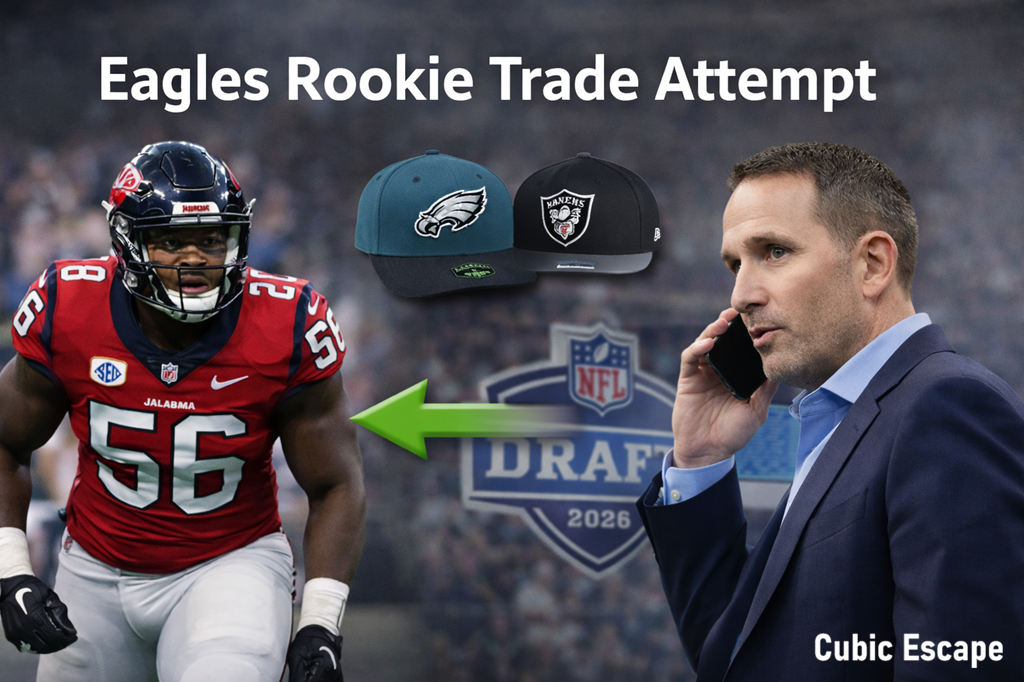
What Was the Eagles Rookie Trade Attempt?
In the 2025 NFL Draft, the Philadelphia Eagles attempted to trade into the top 20, reportedly near pick No. 18, to select Alabama linebacker Jihaad Campbell. When the compensation demands became too high, the team chose not to proceed with the larger trade. Instead, Philadelphia later moved up one spot from No. 32 to No. 31 and successfully drafted Campbell.
This sequence defines the Eagles Rookie Trade Attempt. It shows aggressive interest balanced with long term roster control under general manager Howie Roseman. Rather than overpaying, the Eagles secured their target while protecting future draft capital. As a result, the team strengthened its defense without weakening its draft position.
Why the Eagles Targeted Jihaad Campbell
Entering the draft, Philadelphia had a clear defensive need. Modern NFL offenses rely on spacing, motion, and speed. Therefore, linebackers must cover space quickly and make fast decisions.
Campbell matched that profile.
He offered:
- Strong sideline to sideline range
- Reliable pass coverage skills
- Solid run defense awareness
- Leadership from a top college program
Because linebacker play connects the defensive line and secondary, adding speed at that position can improve the entire defense. For that reason, the Eagles viewed Campbell as a long term building block rather than short term depth.
Why the Trade Into the Top 20 Did Not Happen
Reports indicate that teams holding picks inside the top 20 demanded significant compensation. That likely included valuable future draft selections.
At that point, the Eagles faced a decision. They could guarantee their target by overpaying. Or they could trust their draft board and remain patient.
They chose patience.
Soon after, unexpected selections caused Campbell to slide. Consequently, Philadelphia needed only a minor move up one spot to secure him. This outcome preserved flexibility while achieving the same goal.
The Eagles Rookie Trade Attempt therefore became a story of timing rather than force.
What This Reveals About Draft Risk Management
The Eagles Rookie Trade Attempt also highlights disciplined draft risk management.
Trading into the top 20 often requires:
- Giving up future second or third round picks
- Reducing flexibility in the following draft
- Increasing pressure on the rookie to justify the cost
By declining the larger trade, Philadelphia reduced long term risk. At the same time, the team maintained its ability to stay active in future drafts.
Successful organizations understand that draft value matters as much as draft talent. In this case, the Eagles protected both.
Howie Roseman’s Draft Philosophy in Action
Howie Roseman has built a consistent draft identity. He explores bold moves. However, he rarely commits beyond fair value.
His approach often follows three clear steps:
- Identify elite traits
- Explore every trade path
- Refuse emotional decisions
Because of this structure, the Eagles avoid long term damage from short term pressure. The Campbell situation fits that pattern clearly.
Supporting Moves That Strengthened the Roster
The Eagles Rookie Trade Attempt occurred within a broader plan to balance the roster.
Thomas Booker for Jakorian Bennett
Shortly after the draft, Philadelphia traded defensive tackle Thomas Booker to the Raiders for cornerback Jakorian Bennett.
This move converted defensive line depth into secondary support. Although it did not dominate headlines, it improved positional balance and long term depth planning.
Adding Sam Howell for Stability
Later in 2025, the Eagles traded for quarterback Sam Howell to reinforce depth behind Jalen Hurts.
At the time, backup Tanner McKee was dealing with a minor injury. Therefore, the front office acted early rather than reacting under pressure. Strong quarterback depth supports stability across a long season.
Impact on 2026 Draft Capital
One important element often overlooked is draft capital.
Because the Eagles did not overpay to reach the top 20, they preserved valuable future selections. Philadelphia is projected to hold multiple picks in the 2026 NFL Draft, including possible compensatory selections.
Maintaining draft capital matters because it:
- Supports roster depth
- Allows future trade flexibility
- Protects salary cap balance
Therefore, the disciplined decision in 2025 supports flexibility beyond a single season.
Separating Confirmed Moves From Rumors
During this period, rumors surfaced about possible trades involving players such as A.J. Brown. However, no confirmed trade occurred.
Similarly, early 2026 discussions about a possible Tanner McKee trade remain speculative unless officially completed.
It is important to separate verified transactions from league discussion. The confirmed event remains the successful selection of Campbell after a disciplined trade decision.
Why This Story Matters
Many draft trade stories involve regret. Teams sometimes give up significant assets and later struggle with limited flexibility.
The Eagles Rookie Trade Attempt followed a different path:
- The team explored a bold move
- The team declined when value exceeded price
- The team secured the same player anyway
This outcome reflects discipline, not hesitation. It also highlights alignment between scouting, coaching, and leadership.
Conclusion
The Eagles Rookie Trade Attempt during the 2025 NFL Draft illustrates how the Philadelphia Eagles build competitive rosters. The team pursued Jihaad Campbell aggressively, explored a trade into the top 20, then stepped back when the cost became too high. Ultimately, they selected him at No. 31 through a minor trade.
By strengthening linebacker depth, reinforcing the secondary, protecting quarterback stability, and preserving future draft capital, the Eagles improved both present performance and long term flexibility.
This was not a missed opportunity. It was controlled execution. That disciplined approach continues to define Philadelphia’s roster building strategy.
Frequently Asked Questions (FAQs)
What was the Eagles Rookie Trade Attempt?
The Eagles Rookie Trade Attempt was the Philadelphia Eagles’ effort during the 2025 NFL Draft to trade into the top 20 for Jihaad Campbell before ultimately selecting him at No. 31.
Why did the Eagles not complete the top 20 trade?
The reported asking price required significant draft compensation. The Eagles chose not to overpay and instead waited for the draft board to shift.
How did this decision affect future draft picks?
By avoiding an expensive trade, Philadelphia preserved valuable draft capital, including projected 2026 selections and possible compensatory picks.
Did the Eagles trade any major players during this attempt?
No confirmed major player trades occurred as part of the draft move. The key completed action was selecting Campbell through a small trade up.
Don’t miss the next big move. Stay updated with Cubic Escape.